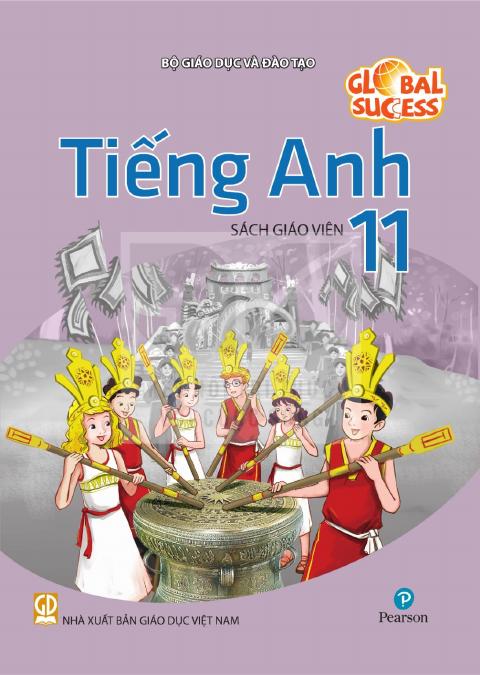
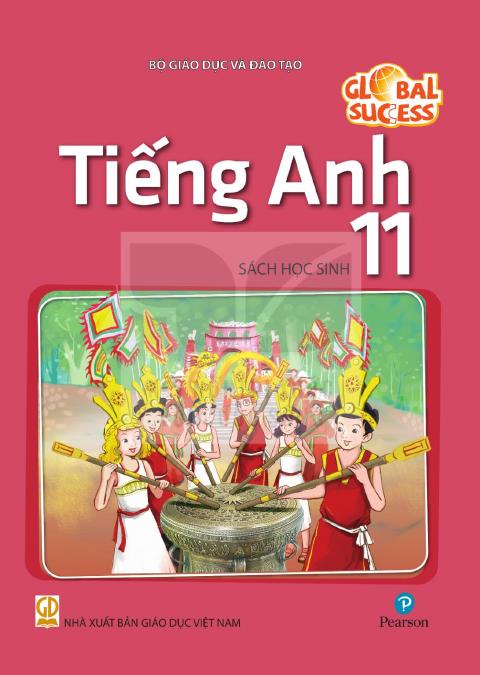
Tiếng Anh 11 - Global Success - sách giáo viên
Báo tài liệu không phù hợp
Xem trước nội dung
Tiếng Anh 11 Global Success is the second level of a
three-level English language course for Vietnamese
students in upper secondary schools. It follows the
systematic cyclical, and theme-based curriculum issued
by the Ministry of Education and Training accompanying
Gircular No 32/2018/TT-BGDĐT, on26th December 2018,
The aim of this series of textbooksis to developstudents'
language skills (listening, speaking,reading and writing)
a5 well as communicative competence so that on
completion of upper secondary schodol, students will
achieve level three of the Vietnamese Forelgn Language
Competence Framework (equivalent to level BỊ in
the Common European Framework of Reference for
Languages).
COMPONENTS OF TIẾNG ANH T
SLOBAL SUCCESS
The course consists of a Students Book, a Teachers Book,
aWorkbook, and a CD,
STUDENT'SBOOK
The Students Book contains:
* a book map which provides information about the
strucfure of the textbook and the sections of each
unit;
* . tentopic-based units, each comprising eightsections
tø be taughtin eight45-minute lessons;
+ four review lessons, each providing revision and
further practice of the language and skills learnt in
preceding units, to be taught in three 45-minute
lessons;
* . glossaryproviding phonetic transcription of keywords
related to the unit topics and their Vietnamese
equivalents,
TEACHER'SBOOK
The Teachers Book gives full procedural notes for
teaching every part of each unit and suggestions for
teaching techniques, which teachers can use depending
on their teaching contexts, It also provides the answer
keys to the activities, suggested answers for speaking
and writing acfivities in the Students Book and the
Workbook, and the audio scripts for the listening tasks
in the Students Book.
WORKBOOK
The Workbook mirrors and reinforces the content of the
Students Book. It offers further practice of the language
and skills taught in cdlass, and four additional tests for
students self-assessment,
cD
The CDindudes the audio for the listening activities,
THE STRUCTURE OF EACH UNIT
The Student“s Book consists of ten units. Each unit starts
with an overview of the language and skills points,
the communication and culture / CLIL topics, and the
Pproject, and indludes eight sections providing input for
eight 45-minute lessons, These theme-based units are
designed to provide students with memorable lessons
and enjoyable learning experience,
SECTION 1: GETTING STARTED
Getting Started is the first section of the unit. It begins
with a conversation which introduces the unit topic,
some target vocabulary, and the grammar items. This ïs
followed by a number of activities for chedking students'
comprehension and helping them identify and/or
Practise the vocabulary and grammatical structures
Ppresented in this section.
SECTION 2: LANGUAGE
The Language section comprises three subsections:
Pronunciation, Vocabulary, and Grammar. In the
Vocabulary and Grammar subsections, some of the
vocabulary and grammar points presented in Getting
Started are now practised in more depth. In addition,
some new ones are taught so that students can expand
their vocabulary and grammar knowledge, and have
more language items at their disposal later in the unit.
In the Pronunciation subsection, students are given the
opportunity to practise features of connected speech,
rhythm and sentence stress, and intonation patterns,
which are considered to be aspects of pronunciation
difficult to master by learners.
When teaching these subsections, it is advisable that
you focus students attention on the three aspects of
a new language point - form, meaning, and use. The
three aspects of the grammar points are summarised
in the Remember! boxes, where extra examples are
also provided. In the Vocabulary subsection, a special
emphasis is also given tø collocations or words that
are often used together, which students need to
learn to sound more natural and idiomatic In some
Pronunciation subsections, there are …
Trên đây là phần đầu tài liệu — bấm Đọc sách để xem đầy đủ.