ĐỀ THI TUYỂN SINH LỚP 10 TRƯỜNG THPT CHUYÊN LÊ HỒNG PHONG, NAM ĐỊNH NĂM HỌC 2019 2020. Môn thi TIẾNG ANH (Đề chuyên) Mã A476465
Báo tài liệu không phù hợp
Xem trước nội dung
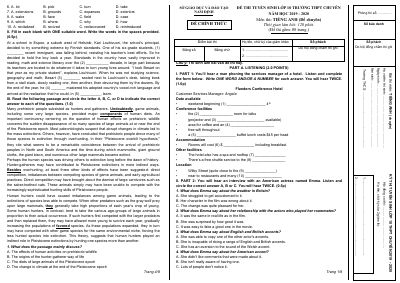
6. A. lot B. pick C. turn D. take 7. A. extensions B. grounds C. expanses D. exteriors 8. A. wake B. face C. field D. case 9. A. which B. where C. why D. how 10. A. revitalized B. revived C. rediscovered D. reintroduced II. Fill in each blank with ONE suitable word. Write the words in the spaces provided. (0.5p). At a school in Espoo, a suburb west of Helsinki, Kari Louhivuori, the school’s principal, decided to try something extreme by Finnish standards. One of his six-grade students, (1) ________ recent immigrant, was falling behind, resisting his teacher’s best efforts. So he decided to hold the boy back a year. Standards in the country have vastly improved in reading, math and science literacy over the (2) ___________ decade, in large part because its teachers are trusted to do whatever it takes to turn young lives around. “I took Besart on that year as my private student”, explains Louhivuori. When he was not studying science, geography and math, Besart (3) ________ seated next to Louhivuori’s desk, taking book from a stall stack, slowly reading one, then another, then devouring them by the dozens. By the end of the year, he (4) _______ mastered his adopted country’s vowel-rich language and arrived at the realization that he could, in (5) __________, learn. III. Read the following passage and circle the letter A, B, C, or D to indicate the correct answer to each of the questions. (1.0) Many prehistoric people subsisted as hunters and gatherers. Undoubtedly, game animals, including some very large species, provided major components of human diets. An important controversy centering on the question of human effects on prehistoric wildlife concerns the sudden disappearance of so many species of large animals at or near the end of the Pleistocene epoch. Most paleontologists suspect that abrupt changes in climate led to the mass extinctions. Others, however, have concluded that prehistoric people drove many of those species to extinction through overhunting. In their "Pleistocene overkill hypothesis," they cite what seems to be a remarkable coincidence between the arrival of prehistoric peoples in North and South America and the time during which mammoths, giant ground sloths, the giant bison, and numerous other large mammals became extinct. Perhaps the human species was driving others to extinction long before the dawn of history. Hunter-gatherers may have contributed to Pleistocene extinctions in more indirect ways. Besides overhunting, at least three other kinds of effects have been suggested: direct competition, imbalances between competing species of game animals, and early agricultural practices. Direct competition may have brought about the demise of large carnivores such as the saber-toothed cats. These animals simply may have been unable to compete with the increasingly sophisticated hunting skills of Pleistocene people. Human hunters could have caused imbalances among game animals, leading to the extinctions of species less able to compete. When other predators such as the gray wolf prey upon large mammals, they generally take high proportions of each year’s crop of young. Some human hunters, in contrast, tend to take the various age-groups of large animals in proportion to their actual occurrence. If such hunters first competed with the larger predators and then replaced them, they may have allowed more young to survive each year, gradually increasing the populations of favored species. As these populations expanded, they in turn may have competed with other game species for the same environmental niche, forcing the less hunted species into extinction. This theory, suggests that human hunters played an indirect role in Pleistocene extinctions by hunting one species more than another. 1. What does the passage mainly discuss? A. The effects of human activities on prehistoric wildlife B. The origins of the hunter-gatherer way of life C. The diets of large animals of the Pleistocene epoch D. The change in climate at …
Trên đây là phần đầu tài liệu — bấm Đọc sách để xem đầy đủ.