Xem trước nội dung
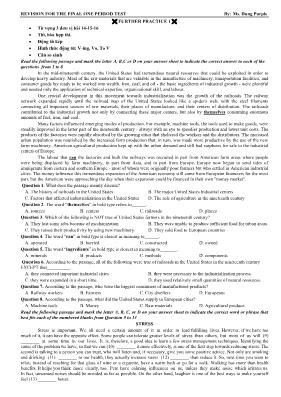
REVISION FOR THE FINAL ONE PERIOD TEST By: Ms. Dung Purple
FURTHER PRACTICE 1 • Từ vựng 3 đơn vị bài 14-15-16 • Thì, hòa hợp thì. • Động từ kép • Hình thức động từ: V-ing, Vo, To V • Câu so sánh Read the following passage and mark the letter A, B,C or D on your answer sheet to indicate the correct answer to each of the questions from 1 to 8
In the mid-nineteenth century, the United States had tremendous natural resources that could be exploited in order to develop heavy industry. Most of the raw materials that are valuable in the manufacture of machinery, transportation facilities, and consumer goods lay ready to be worked into wealth. Iron, coal, and oil - the basic ingredients of industrial growth - were plentiful and needed only the application of technical expertise, organizational skill, and labour.
One crucial development in this movement towards industrialization was the growth of the railroads. The railway network expanded rapidly until the railroad map of the United States looked like a spider's web, with the steel filaments connecting all important sources of raw materials, their places of manufacture, and their centers of distribution. The railroads contributed to the industrial growth not only by connecting these major centers, but also by themselves consuming enormous amounts of fuel, iron, and coal.
Many factors influenced emerging modes of production. For example, machine tools, the tools used to make goods, were steadily improved in the latter part of the nineteenth century - always with an eye to speedier production and lower unit costs. The products of the factories were rapidly absorbed by the growing cities that sheltered the workers and the distributors. The increased urban population was nourished by the increased farm production that, in turn, was made more productive by the use of the new farm machinery. American agricultural production kept up with the urban demand and still had surpluses for sale to the industrial centers of Europe.
The labour that ran the factories and built the railways was recruited in part from American farm areas where people were being displaced by farm machinery, in part from Asia, and in part from Europe. Europe now began to send tides of immigrants from eastern and southern Europe - most of whom were originally poor farmers but who settled in American industrial cities. The money tofinance this tremendous expansion of the American economy still came from European financiers for the most part, but the American were approaching the day when their expansion could be financed in their own "money market". Question 1. What does the passage mainly discuss? A. The history of railroads in the United States B. The major United States industrial centers C. Factors that affected industrialization in the United States D. The role of agriculture in the nineteenth century Question 2. The word “themselves” in bold type refers to______. A. sources B. centers C. railroads D. places Question 3. Which of the following is NOT true of United States farmers in the nineteenth century? A. They lost some jobs because of mechanization B. They were unable to produce sufficient food for urban areas. C. They raised their productivity by using new machinery. D. They sold food to European countries Question 4. The word “ran” in bold type is closest in meaning to______. A. operated B. hurried C. constructed D. owned Question 5. The word “ingredients” in bold type is closest in meaning to_______. A. minerals B. products C. methods D. components Question 6. According to the passage, all of the following were true of railroads in the United States in the nineteenth century EXCEPT that__________. A. they connected important industrial cities B. they were necessary to the industrialization process. C. they were expanded in a short time. D. they used relatively small quantities of natural resources. Question 7. According to the passage, who were the biggest consumers of manufactured products? A. Railway …
Trên đây là phần đầu tài liệu — bấm Đọc sách để xem đầy đủ.