
Xem trước nội dung
Page 1
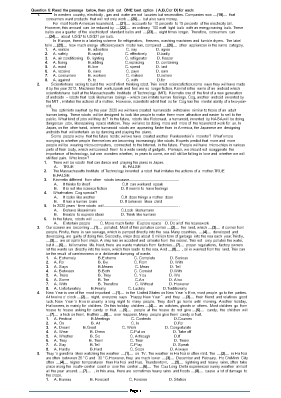
Question 6: Read the passage below, then pick out ONE best option ( A,B,C or D) for each:
1. In western country, electricity , gas and water are not luxuries but necessities. Companies now ....(19).... that consumers want products that will not only work ....(20).... but also save money. For most North American household, ....(21).... accounts for 10 percents to 15 percents of the electricity bill. However, this amount can be reduced by ....(22).... an ordinary 100 watt light bulb with an energy-saving bulb. These bulbs use a quarter of the electricity of standard bulbs and ....(23).... eight times longer. Therefore, consumers can ....(24).... about US$7 to US$21 per bulb. In Europe, there is a labeling scheme for refrigerators, freezers, washing machines and tumble dryers. The label tells ....(25).... how much energy efficiency each model has, compared ....(26).... other appliances in the same category. 1. A. realize B. advertise C. say D. agree 2. A. safely B. rapidly C. effectively D. badly 3. A. air conditioning B. lighting C. refrigerator D. freezer 4. A. fixing B. adding C. replacing D. combining 5. A. exist B. live C. spend D. last 6. A. receive B. save C. pays D. earn 7. A. consumers B. workers C. makers D. sellers 8. A. against B. to C. with D. for 2. Scientists are racing to build the world’s first thinking robot. This is not science fiction:some says they will have made it by the year 2012. Machines that walk, speak and feel are no longer fiction. Kismet is the name of an android which scientists have built at the Massachusetts Institude of Technology (MIT). Kismet is one of the first of a new generation of androids – robots that look like human beings – which can imitate human feelings. Cog, another android invented by the MIT , imitates the actions of a mother. However, scientists admit that so far Cog has the mental ability of a two-year- old. The optimists say that by the year 2020 we will have created humanoids with brains similar to those of an adult human being. These robots will be designed to look like people to make them more attractive and easier to sell to the public. What kind of jobs will they do? In the future, robots like Robonaut, a humanoid, invented by NASA, will be doing dangerous jobs, like repairing space stations. They will also be doing more and more of the household work for us. In Japan, on the other hand, where humanoid robots are appearing faster than in America, the Japanese are designing androids that will entertain us by dancing and playing the piano. Some people worry that the future holds: will we have created another Frankenstein’s monster? What’s more worrying is whether people themselves are becoming increasingly like robots. Experts predict that more and more people will be wearing micro-computers, connected to the Internet, in the future. People will have micro-chips in various parts of their body, which will connect them to a wide variety of gadgets. Perhaps, we should not exaggerate the importance of technology, but one wonders whether, in years to come, we will still be falling in love and whether we will still feel pain. Who know? 1. There will be robots that can dance and playing the piano in Japan.
A. TRUE B. FALSE 2. The Massachusetts Institute of Technology invented a robot that imitates the actions of a mother.TRUE B. FALSE 3. Kismet is different from other robots because..................................................
A. It thinks for itself C. It can walk and speak B. It is not like science fiction D. It seems to have feelings 4. What makes Cog special?
A. It looks like another C. It does things a mother does B. It has a human brain D. It behaves like a child 5. In 2020 years ' time robots will ...........................................................................
A. Behave like animals C. Look like humans B. Be able to express ideas D. Think like humans 6. In the future, robots will …
Trên đây là phần đầu tài liệu — bấm Đọc sách để xem đầy đủ.