Đề thi vào lớp 6 môn Tiếng Anh trường Amsterdam 2019 có đáp án
Báo tài liệu không phù hợp
Xem trước nội dung
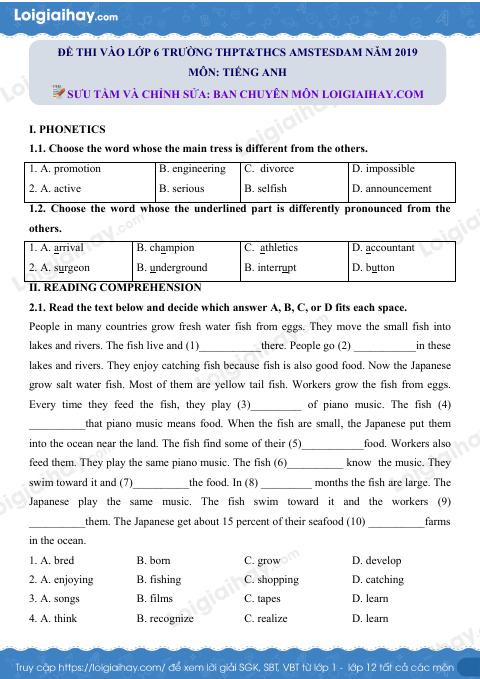
I. PHONETICS
1.1. Choose the word whose the main tress is different from the others.
1. A. promotion
2. A. active
B. engineering
B. serious
C. divorce
B. selfish
D. impossible
D. announcement
1.2. Choose the word whose the underlined part is differently pronounced from the
others.
1. A. arrival
2. A. surgeon
B. champion
B. underground
C. athletics
B. interrupt
D. accountant
D. button
II. READING COMPREHENSION
2.1. Read the text below and decide which answer A, B, C, or D fits each space.
People in many countries grow fresh water fish from eggs. They move the small fish into
lakes and rivers. The fish live and (1)___________there. People go (2) ___________in these
lakes and rivers. They enjoy catching fish because fish is also good food. Now the Japanese
grow salt water fish. Most of them are yellow tail fish. Workers grow the fish from eggs.
Every time they feed the fish, they play (3)_________ of piano music. The fish (4)
__________that piano music means food. When the fish are small, the Japanese put them
into the ocean near the land. The fish find some of their (5)___________food. Workers also
feed them. They play the same piano music. The fish (6)__________ know the music. They
swim toward it and (7)__________the food. In (8) _________ months the fish are large. The
Japanese play the same music. The fish swim toward it and the workers (9)
__________them. The Japanese get about 15 percent of their seafood (10) __________farms
in the ocean.
1. A. bred B. born C. grow D. develop
2. A. enjoying B. fishing C. shopping D. catching
3. A. songs B. films C. tapes D. learn
4. A. think B. recognize C. realize D. learn
ĐỀ THI VÀO LỚP 6 TRƯỜNG THPT&THCS AMSTESDAM NĂM 2019
MÔN: TIẾNG ANH
SƯU TẦM VÀ CHỈNH SỬA: BAN CHUYÊN MÔN LOIGIAIHAY.COM
5. A. own B. private C. self D. individual
6. A. recently B. mostly C. nearly D. already
7. A. see B. find C. bite D. hold
8. A. few B. a few C. couple D. many
9. A grasp B. catch C. seize D. hold
10. A. on B. of C. from D. in
2.2. Read the following passage and mark the letter A, B, C, or D to indicate the correct
answer to each of the questions.
Past explorers have made vast contributions to our knowledge of the world today. They
braved the oceans to discover the world and to bring their goods to other countries to trade.
Many explorers had to overcome their fear of the unknown to travel around the world on
their sailing ships. Submitting themselves to unpredictable weather conditions, each explorer
either traveled further than his predecessor or tried to find a different route to already
discovered countries. For example, Vasco Da Gama, a Portuguese explorer, established a sea
route from Europe to India. He had extended the sea route that Bartolomeu Dias had already
done when he latter sailed around the Cape of Good Hope in southern Africa.
More importantly, explorers first closed the gap between the east and the west by trading
their local goods with foreign ones. India was known for its spices such as nutmeg and
cinnamon while China was known for its silk. A part of the east was brought to the west
when western gourmets developed a taste for eastern spices in their food. People in the east
dressed in clothes that were previously only worn in the west. Without the explorers, many
of us would still be living in our own enclave with little knowledge of the vast world and
what other foreign countries have to offer us.
1. Past explorers contributed to our knowledge of the world by ___________.
A. making new good B. selling their goods at high prices
C. travelling to other countries D. spending time reading about foreign countries
2. Past explorers were probably fearful of ___________.
A. swimming in the ocean
B. the dangers that lurked in unexplored places
Trên đây là phần đầu tài liệu — bấm Đọc sách để xem đầy đủ.