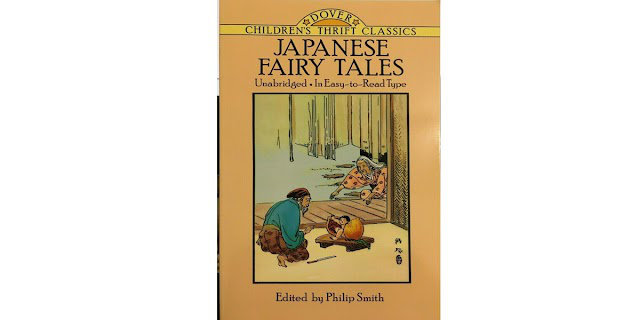

Japanese Fairy Tales
Báo tài liệu không phù hợp
Xem trước nội dung
The Project Gutenberg EBook of Japanese Fairy Tales, by Yei Theodora Ozaki
This eBook is for the use of anyone anywhere at no cost and with
almost no restrictions whatsoever. You may copy it, give it away or
re-use it under the terms of the Project Gutenberg License included
with this eBook or online at
Title: Japanese Fairy Tales
Author: Yei Theodora Ozaki
Posting Date: June 4, 2009 [EBook #4018]
Release Date: May, 2003
First Posted: October 11, 2001
Language: English
*** START OF THIS PROJECT GUTENBERG EBOOK JAPANESE FAIRY TALES ***
Produced by Charles Franks, Greg Weeks and the Online
Distributed Proofreading Team. HTML version by Al Haines.
JAPANESE FAIRY TALES
COMPILED BY
YEI THEODORA OZAKI
Profusely Illustrated by Japanese Artists
TO
ELEANOR MARION-CRAWFORD.
I DEDICATE THIS BOOK TO YOU AND TO THE SWEET CHILD-
FRIENDSHIP THAT YOU GAVE ME IN THE DAYS SPENT WITH YOU BY
THE SOUTHERN SEA, WHEN YOU USED TO LISTEN WITH
UNFEIGNED PLEASURE TO THESE FAIRY STORIES FROM FAR JAPAN.
MAY THEY NOW REMIND YOU OF MY CHANGELESS LOVE AND
REMEMBRANCE.
Y. T. O.
Tokio, 1908.
PREFACE.
This collection of Japanese fairy tales is the outcome of a suggestion made to
me indirectly through a friend by Mr. Andrew Lang. They have been translated
from the modern version written by Sadanami Sanjin. These stories are not
literal translations, and though the Japanese story and all quaint Japanese
expressions have been faithfully preserved, they have been told more with the
view to interest young readers of the West than the technical student of folk-lore.
Grateful acknowledgment is due to Mr. Y. Yasuoka, Miss Fusa Okamoto, my
brother Nobumori Ozaki, Dr. Yoshihiro Takaki, and Miss Kameko Yamao, who
have helped me with translations.
The story which I have named "The Story of the Man who did not Wish to
Die" is taken from a little book written a hundred years ago by one Shinsui
Tamenaga. It is named Chosei Furo, or "Longevity." "The Bamboo-cutter and
the Moon-child" is taken from the classic "Taketari Monogatari," and is NOT
classed by the Japanese among their fairy tales, though it really belongs to this
class of literature.
The pictures were drawn by Mr. Kakuzo Fujiyama, a Tokio artist.
In telling these stories in English I have followed my fancy in adding such
touches of local color or description as they seemed to need or as pleased me,
and in one or two instances I have gathered in an incident from another version.
At all times, among my friends, both young and old, English or American, I have
always found eager listeners to the beautiful legends and fairy tales of Japan, and
in telling them I have also found that they were still unknown to the vast
majority, and this has encouraged me to write them for the children of the West.
Y. T. O.
Trên đây là phần đầu tài liệu — bấm Đọc sách để xem đầy đủ.